
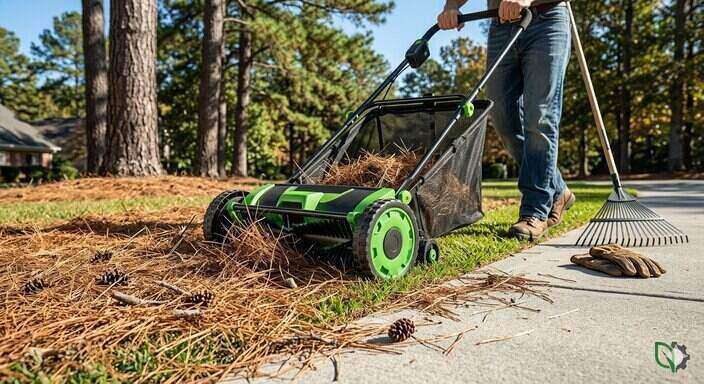
If you are lucky enough to have towering, majestic pine trees flanking your property, you also know the dark side of that blessing: the endless, choking carpet of brown needles. Unlike broad autumn leaves that blow away or break down quickly, pine needles intertwine, form dense mats, and acidicly suffocate your turf. If you are tired of blistering your hands with a traditional rake, you have likely looked at a mechanical shortcut. The burning question on your mind is simple: will a push lawn sweeper pick up thick pine needles, or will it just glide right over them?
When I’m out in the yard battling my own seasonal cleanup, efficiency is everything. I don’t want to spend three weekends doing a job that should take an afternoon. In my experience, a standard leaf sweeper can handle this task, but pine straw is notoriously stubborn compared to grass clippings. To get the job done right without the machine jamming or slipping, you need to rely on the right equipment. Investing in the best push lawn sweeper for pine needles makes a massive difference because it combines a high brush-to-wheel rotation ratio with stiff, rugged bristles that can actually dig into the thatch layer. Let’s look at the cold, hard facts of how these machines perform when facing a heavy blanket of pine needles.
The Reality Check: Sweeper Mechanics vs. Pine Straw Anatomy
There is a common misconception that lawn sweepers work like outdoor household vacuum cleaners. They don’t. They rely entirely on mechanical traction—your forward momentum turns the wheels, which spins a series of internal brushes that flick debris upward into a collection hopper bag.
Because of this design, pine needles present a unique set of challenges that standard leaves do not:
- The Interlocking Web: Pine needles feature tiny microscopic ridges. When they fall, they weave together like a wicker basket, creating a matted layer that resists being pulled apart by light sweeping action.
- Weight and Moisture: Fresh or rain-soaked pine straw is surprisingly heavy and dense. If the needles have sat on your grass for months, they settle deeply into the crown of your turf blades.
- Slippage: If your sweeper’s brushes hit a mat of needles that is too thick, the brushes can stall, causing the plastic wheels to simply skid across your lawn rather than turning the internal gears.
Read More: How to Adjust Your Lawn Sweeper Height for Maximum Pine Straw Pick Up?
Myth vs. Fact: Debunking Lawn Sweeper Expectations
Before you drop money on a new tool or pull yours out of the shed, let’s clear up some common myths surrounding how well a push lawn sweeper will pick up thick pine needles.
Myth 1: You can just walk at a casual pace and the sweeper will grab everything in a single pass.
- Fact: Thick pine straw almost always requires a multi-pass approach. In my experience, the first pass breaks up the interlocking web and grabs the loose top layer, while the second pass digs out the embedded needles. You also need to maintain a brisk, steady walking pace to keep the brush RPMs high enough to flick the heavy straw backward into the hopper.
Myth 2: Setting the brushes as low as possible yields the best results.
- Fact: This is the fastest way to ruin your machine. Lowering the brushes so they scrape the dirt increases resistance dramatically. This strips the internal plastic gears, locks up the wheels, and scalps your grass. The brushes should only ever skim the top half-inch of your turf blades.
Myth 3: Wet pine needles are easier to sweep because they clump together.
- Fact: Saturated pine needles are a nightmare for a push sweeper. The wet straw sticks to the bristles, clogs the entry chute of the hopper, and adds too much weight, causing the drive wheels to lose traction entirely. Always wait for a string of dry, sunny days before attempting a sweeping run.
How to Successfully Sweep Thick Pine Needles (FAQ)
What is the best strategy for clearing an absolute blanket of thick needles?
If your lawn looks more like a forest floor, do not start with the sweeper. Use a leaf blower or a sturdy landscape rake to pull the heaviest piles off the grass first. Once the density is reduced to a uniform layer of an inch or less, bring in the push sweeper to clean up the rest. Think of the sweeper as your precision finishing tool, not a heavy bulldozer.
Can I adjust my sweeper to improve traction on slippery pine straw?
Yes. Many seasoned lawn care fanatics modify their push sweepers by adding weight directly over the wheel axle. Taping a heavy brick or a small sandbag to the front frame increases downward pressure. This forces the wheels to dig into the ground and keep spinning, even when the brushes encounter heavy resistance from thick mats.
How do I maintain my sweeper after processing pine needles?
Pine straw releases sticky sap and wraps tightly around rotating components. After every major cleanup session, flip the tool over and manually cut away any long needles wrapped around the brush axle bearings. Wipe down the bristles with a rag damp with a mild degreaser to remove sap buildup, which causes bristles to become brittle and snap over time.
Does the type of grass affect how well a push lawn sweeper will pick up thick pine needles?
Absolutely. Short, stiff turf species like well-manicured Bermuda grass allow needles to sit on top of the lawn, making them incredibly easy for a sweeper to collect. Conversely, thick, spongy, or overgrown grasses like Tall Fescue or St. Augustine allow the slender needles to slip deep between the blades, requiring you to slow down and use multiple cross-cutting passes to lift them out.
Keep your equipment clean, time your cleanups for dry afternoons, and don’t be afraid to walk with a little hustle—you’ll keep your turf completely needle-free all year long.
