
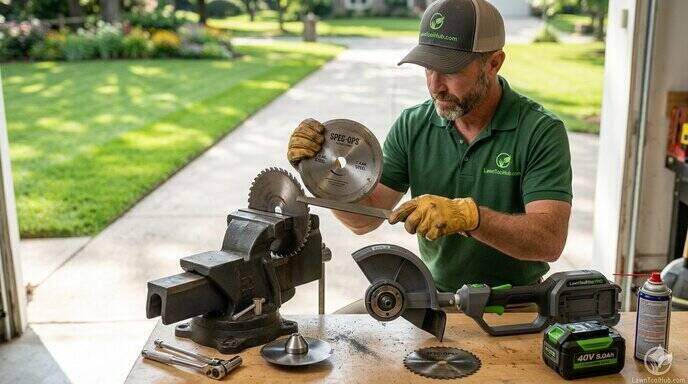
There is nothing quite like looking down your sidewalk and seeing that perfectly manicured, crisp dirt channel separating your lush green grass from the concrete. It instantly elevates your entire home’s curb appeal. When I’m out in the yard on a warm Saturday afternoon, my edger is the MVP that puts the finishing touches on a clean mow. But over the course of a long landscaping season, you might notice your tool starting to bog down, rip at the grass blades, or bounce violently against the dirt. If your machine is suddenly struggling, you are probably asking yourself: can you sharpen a cordless lawn edger blade, or are you forced to buy a replacement every time it goes dull?
Unlike traditional gas engines that can simply force a dull metal disc through hard clay using sheer horsepower, battery-powered equipment runs on a strict energy budget. If you are operating a modern cordless lawn edger with steel blades, keeping that metal edge razor-sharp is absolutely vital. A blunt edge forces the electric motor to pull excessive amperage from your lithium-ion cells, cutting your runtime in half and putting massive thermal strain on the internal circuit boards. Let’s look at the mechanical reality of tool maintenance, look at the math behind when to grind versus when to toss, and walk through exactly how to restore a factory edge right in your own garage.
To Grind or to Replace? The Core Maintenance Breakdown
Before you take an angle grinder to your equipment, you need to know if your specific blade is actually a candidate for maintenance. Not all cordless edger parts are created equal.
| Blade Type & Condition | Can You Sharpen It? | Recommended Action Plan |
| Standard Rectangular Steel | Yes. Highly encouraged to preserve battery runtime. | Grind away minimal material to restore a clean 30-degree bevel. |
| Star-Shaped / Multi-Tooth Steel | Yes, but tedious. Requires sharpening each individual point evenly. | Use a specialized slim diamond file or opt for an affordable swap-out. |
| Severely Curved / Warped Metal | No. Structural integrity is completely compromised. | Throw it out immediately. A warped blade destroys gear head bearings. |
| Composite / Reinforced Plastic | Absolute No. Thermoplastic edges cannot be ground down. | Replace the snap-in composite tabs once they wear down to the indicator lines. |
Detailed How-To: Restoring Your Cordless Edger Blade in 5 Steps
If you have a standard steel blade that is simply dull, rounded, or lightly nicked from riding the concrete curb, restoring its cutting power takes less than fifteen minutes. Here is the exact shop process I use to keep my gear running at peak efficiency.
Step 1: Disconnect the Power and Remove the Assembly
Safety comes first, especially with cordless tools that activate instantly with a trigger squeeze.
- Pop the lithium-ion battery pack entirely out of the tool’s cradle before touching the gear head.
- Insert a locking pin or a screwdriver into the gear housing alignment hole to stop the spindle from spinning.
- Use a socket wrench to unscrew the arbor nut (keep in mind, most edger spindles use left-handed threads, meaning you must turn the nut clockwise to loosen it). Remove the outer flange and lift the blade off the shaft.
Step 2: Secure the Metal in a Workbench Vise
Never attempt to hold a loose piece of sheet metal in your gloved hand while applying a file or power tool to it. Clamp the steel blade firmly into a heavy-duty workbench vise. Position it so that one of the dull, beveled cutting ends is pointing upward and completely accessible.
Step 3: Match the Factory Bevel Angle
Look closely at the edge profile. Edger blades are not sharpened like pocket knives; they do not have a razor-sharp V-shape. Instead, they feature a single-sided, blunt 30-degree to 45-degree bevel designed to shear grass against the soil.
- Using a Hand File: If you want total control, take a 10-inch flat mill bastard file. Push the file across the metal in long, single-direction forward strokes, matching the exact angle of the original factory bevel. Never saw back and forth.
- Using an Angle Grinder / Bench Grinder: If the blade has deep stone nicks, use a 60-grit flap disc on a grinder. Apply incredibly light, passing pressure across the metal. Be careful not to let the steel turn blue or purple, as excessive heat destroys the metal’s factory tempering, making it brittle and prone to shattering.
Step 4: Balance the Blade (The Critical Step)
This is where many DIYers ruin their equipment. Because you are physically shaving away steel, you must remove an identical amount of weight from both ends of the blade.
- Hang the center arbor hole of the blade on a nail driven into your wall or place it on a dedicated cone-style lawn mower blade balancer.
- If one side dips downward, it is too heavy. Take it back to the vise and shave a small amount of metal off the heavy end until the blade hangs perfectly horizontal.
⚠️ Why Balancing Matters
An unbalanced blade spinning at over 4,000 RPM creates immense centrifugal vibration. This vibration will rapidly tear apart the delicate rubber seals and ball bearings inside your cordless tool’s sealed gear case, leading to a catastrophic mechanical failure that cannot be repaired.
Step 5: Clean and Reinstall
Wipe down the blade with a clean rag and spray it with a light coat of WD-40 or multi-purpose tool oil to block rust formation. Slide the blade back onto the spindle, re-seat the matching flange plate, and secure the arbor nut tightly. Spin it with your fingers to ensure it clears the safety guard completely before popping the battery pack back in.
When Should You Stop Sharpening and Buy New?
While the short answer to can you sharpen a cordless lawn edger blade is a definitive yes, steel has its physical limits. You should stop maintaining an old blade and head to the store when you hit these wear markers:
- Loss of Length: Every time you sharpen or run your edger against a concrete curb, the blade grows shorter. If your original 7.5-inch blade has worn down past 6.5 inches, you won’t be able to achieve a deep enough trench depth without dropping the tool housing dangerously close to the concrete.
- Loss of Thickness: If the center of the blade near the arbor hole has become thin, rusted, or structurally pitted from wet soil exposure, it risks snapping in half if it strikes a buried brick or large tree root.
- Severe Cracking: Inspect the metal carefully under a bright shop light. If you see any hairline fractures radiating outward from the center mounting hole, discard the blade immediately. A fractured blade spinning at high speeds can fragment into flying shrapnel.