
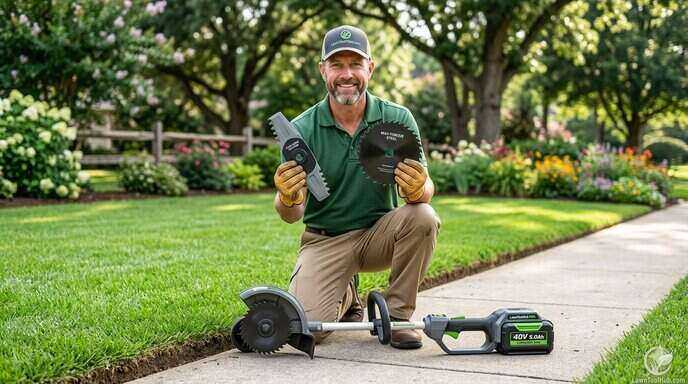
There is nothing quite like looking down a sidewalk and seeing a crisp, laser-straight edge separating the concrete from a dense patch of green turf. It is the ultimate finishing touch that makes a yard pop. When I’m out in the yard on a Saturday morning, my edger is the tool that turns a standard mow into a professional-looking landscape. But if you have recently upgraded from a noisy gas machine to a modern cordless setup, you are faced with an unexpected structural choice. Deciding between plastic vs. steel blades: which is best for battery edgers isn’t just about how clean the cut looks—it directly impacts your machine’s motor life, battery runtime, and overall safety.
Unlike gas engines that rely on brutal, brute-force torque to spin a heavy cutting disc through dirt and rock, battery-powered equipment operates on a tight energy budget. If you choose a premium battery powered lawn edger with a metal blade, you get incredible slicing power through overgrown, thick-season roots, but you also add significant rotational mass. On the flip side, lightweight composite options offer distinct mechanical advantages that many homeowners overlook. Let’s break down the physical realities of these two blade styles so you can maximize your tool’s performance without burning out your battery packs.
Plastic vs. Steel Blades: Which is Best for Battery Edgers? (The Core Comparison)
To make an informed decision for your weekly routine, you have to look at how these materials interact with your cordless tool’s electric motor. They handle resistance, friction, and energy consumption in completely different ways.
| Performance Metric | Polyurethane / Composite Plastic Blades | Hardened Steel Edging Blades |
| Battery Runtime Per Charge | Excellent. Minimal weight reduces startup amp draw, extending battery life by up to 30%. | Moderate. Heavy rotational mass pulls more continuous current from the lithium-ion cells. |
| Overgrowth Slicing Power | Moderate. Great for maintaining existing grooves; struggles against heavy, impacted dirt. | Exceptional. Easily shears through thick soil, encroaching roots, and overgrown sod. |
| Concrete Contact Behavior | Safely bounces or wears down smoothly; zero spark hazard or violent kickback. | Sparks heavily, dulls rapidly, and can cause violent jolts if it binds against concrete. |
| Motor Strain & Heat | Low. Keeps the brushless motor running cool, extending the tool’s long-term lifespan. | High. Striking hidden rocks creates harsh kinetic shocks that travel straight up the drive shaft. |
Read More: How Long Do Cordless Lawn Edger Blades Last?
The Deep-Dive Analysis: Structural Strengths and Weaknesses
Understanding the engineering trade-offs of each blade material helps explain why one might leave your yard looking flawless while the other leaves you frustrated with a dead battery.
Hardened Steel Blades: The Heavyweight Slicers
Traditional steel blades are the gold standard for raw cutting performance. Usually measuring around 7 to 9 inches in length, these rigid pieces of metal are designed to act like a rotating saw blade, establishing a deep, permanent dirt trench along your hardscaping.
- The Pros: If you are establishing a brand-new edge that hasn’t been touched in years, steel is non-negotiable. It cuts through packed clay, handles thick St. Augustine or Bermuda stolons like butter, and holds its structural shape even when dragged through hard soil.
- The Cons: Weight is the enemy of a battery pack. Spinning a heavy steel disc requires a massive surge of initial electrical current. If you frequently strike the concrete curb, the sudden deceleration places immense thermal stress on the electronic speed controllers (ESC) inside your cordless tool, causing the battery to overheat and shut down prematurely.
Composite Plastic Blades: The Efficiency Champions
Modern polymer and heavy-duty nylon blades are specifically engineered to solve the weight dilemma of cordless outdoor power equipment. They look similar to small, thick ceiling fan blades or aerodynamic plastic tabs that mount onto a central spinning hub.
- The Pros: They are incredibly lightweight. Because the motor doesn’t have to fight heavy inertia, it reaches maximum RPM instantly and uses far less energy to maintain that speed. Additionally, plastic is highly forgiving. If you accidentally drift onto your concrete driveway, the plastic blade gently wears down or flexes instead of jarring your wrists and chipping your hardscaping.
- The Cons: Plastic blades are wear-and-tear items. They rely on speed rather than mass to cut, meaning they will erode quickly if your soil is highly abrasive, sandy, or filled with small gravel pebbles. They are strictly maintenance blades, not heavy-duty excavation tools.
How to Match the Blade to Your Specific Lawn Conditions
Instead of guessing which setup to use, I always recommend analyzing the current state of your lawn edges and your specific tool model before swapping out components.
When to Equipe a Steel Blade:
- The First Cut of the Season: Use steel in early spring to redefine your trenches after winter shifting.
- High-Voltage Tools ($56\text{V} – 80\text{V}$): If you own a high-output commercial cordless edger, the motor has enough torque to handle steel without stalling.
- Tough Turf Varieties: Dense, aggressive creeping grasses like Bermuda or Zoysia require the shearing action of metal to prevent the runners from wrapping around the spinning head.
When to Switch to a Plastic Blade:
- Standard Compact Edgers ($18\text{V} – 20\text{V}$): Lower-voltage tools thrive on plastic because it keeps the motor from bogging down and pulling excessive amperage.
- You Have Delicate Hardscaping: If your walkways are flanked by expensive custom-painted pavers, soft limestone, or delicate brickwork, plastic ensures you won’t leave dark metallic scrape marks or chips on the stone.
- Weekly Upkeep: If your edge is already established and you are simply slicing away tiny new blades of grass every weekend, plastic will get the job done faster while saving your battery power for the string trimmer and leaf blower.
Real-World Maintenance and Operational Safety Tips
Regardless of which side you take in the plastic vs. steel blades: which is best for battery edgers debate, running these high-speed tools requires a few best practices to ensure you don’t ruin your equipment or compromise your safety.
1. The “Air-Start” Technique
Never start your battery edger with the blade resting directly inside the dirt trench. Pushing the trigger while the blade is bound by soil causes a massive current spike that can instantly trip the tool’s internal circuit breaker or blow a fuse in the battery pack. Always lift the blade an inch above the ground, pull the trigger to let the motor reach full RPM in the open air, and then gently drop it into the grooming channel.
2. Shaft Inspection and Debris Removal
Because battery edgers run incredibly quiet compared to gas models, it is easy to miss the sound of friction strain. Every few uses, pop the battery out and spin the blade assembly by hand. Check for tightly wound grass fibers, long weeds, or discarded landscaping twine wrapped around the gear head spindle. A wrapped spindle creates hidden mechanical drag, draining your battery 20% faster without your knowledge.
3. Sharpness Checks for Metal Blades
If you choose to run steel, remember that a dull metal blade does not cut; it hacks, tears, and bludgeons the grass roots. This leaves frayed, brown tips along your edge that are highly susceptible to lawn diseases. Use a flat mill file or an angle grinder to restore a clean, 30-degree working edge to your steel blade once a month, or replace it entirely when it loses its original rectangular geometry.