
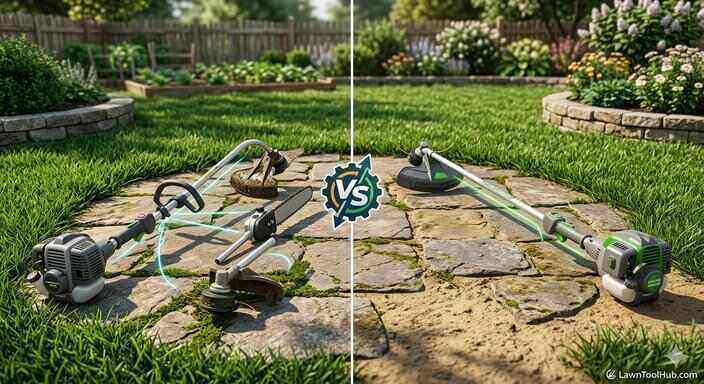
Few things ruin the pristine look of a custom brick patio or interlocking driveway faster than a breakout of bright green, fuzzy moss creeping through the joints. It loves shaded corners, poor drainage, and damp weather, slowly taking over the spaces between your stonework. When I’m out in the yard tackling spring cleanup, getting rid of this slick growth is always high on my priority list. But before you grab the nearest stiff bristle head from your garage shelf, you need to understand the structural risks involved. Choosing between nylon vs. wire brushes: which is safer for removing paver moss isn’t just about speed—it is about preserving your expensive hardscaping from permanent, irreversible surface damage.
If you have a large patio or a sprawling walkway to clear, doing the job with a manual hand scraper will leave you with a sore back and raw blisters by Sunday night. Investing in a dedicated handheld motorized brush for clearing paver moss saves a massive amount of physical labor, but these high-RPM power tools multiply the friction forces applied to your stone. Let’s separate the marketing myths from real-world hardscape engineering so you can pick the right material for your specific stone type, protect your joint sand, and keep your patio looking flawless for years.
Myth vs. Fact: Debunking Hardscape Cleaning Misconceptions
When searching for the best tool to strip away moss roots, it is incredibly easy to follow well-meaning but destructive online advice. Let’s bust the most common misconceptions floating around the lawn care community.
Myth 1: Steel wire brushes are safe for all concrete pavers because stone is harder than metal.
- The Fact: Carbon steel and brass wire wheels will aggressively gouge residential concrete pavers. Most standard yard pavers are made of compressed aggregate and cement with a dyed top finish layer. High-velocity steel bristles easily scratch away this thin aesthetic finish, exposing the rough sand particles underneath and creating permanent, unsightly dull gray tracks across your patio.
Myth 2: Nylon bristles are too soft to completely dislodge stubborn, deep-rooted moss spores.
- The Fact: Heavy-gauge, structural nylon running on a motorized spindle generates immense centrifugal force and friction. It relies on high rotational speed rather than sharp abrasive cutting action. In my experience, a thick nylon wire will cleanly detach the moss plant from the joint walls without scratching the stone face, leaving a perfectly clean surface behind.
Myth 3: If a wire brush doesn’t leave immediate dark marks, it isn’t doing any long-term damage.
- The Fact: Wire bristles create microscopic micro-fissures in the paver surface that you cannot easily see from a standing height. These tiny scratches compromise the factory sealant, transforming the smooth stone into a porous sponge. Water gets trapped inside these micro-grooves, accelerating freeze-thaw cracking during winter and giving future moss spores a perfect, rough anchor point to grow back twice as fast.
Nylon vs. Wire Brushes: The Definitive Feature Breakdown
Choosing between these two materials depends almost entirely on the chemical composition and age of your hardscape materials. Let’s examine how nylon vs. wire brushes: which is safer for removing paver moss plays out across different stone categories.
| Characteristic | Industrial-Grade Nylon Bristles | High-Tensile Steel / Brass Wire |
| Primary Safety Profile | Ultra-Safe. Will not score concrete, brick, or natural stone faces. | High Risk. Prone to scoring concrete and leaving rust stains. |
| Material Lifespan | Moderately short. Fray and wear down quickly against rough stone surfaces. | Extremely durable. Resists abrasion but bristles break off over time. |
| Best Suited For | Concrete pavers, clay face bricks, stamped concrete, flagstone. | Natural granite blocks, unpolished cobbles, heavy industrial concrete. |
| Joint Sand Impact | Lightly sweeps surface sand; leaves underlying compaction intact. | Deeply plows out sand, requiring a full polymeric sand refill. |
Concrete and Clay Pavers: Stick to Nylon
Standard residential pavers are vulnerable to surface abrasion. Nylon bristles flex when they strike the uneven edges of interlocking stones. This elasticity allows them to whip into the joints, strip away the organic plant matter, and bounce off the stone face without leaving a scratch.
Natural Hard Stone: The Wire Exception
If your driveway is constructed from solid, unpolished granite cobblestones or heavy, rustic volcanic basalt, a wire brush can be used safely. These natural stones are incredibly dense and lack artificial color pigments, meaning they can handle the abrasive scraping action of a metal wheel without showing wear tracks.
The Practical FAQ Section
Won’t a motorized nylon brush pull out all my joint sand?
Any mechanical brushing action will remove a tiny layer of sand from the top quarter-inch of the joint. However, because nylon bristles bend and glide over resistance, they cause significantly less disturbance to the deep, compacted sand foundation than rigid steel wires, which act like tiny shovels digging out your base layer.
How do I stop a wire brush from leaving dark gray or metallic streaks on my bricks?
If you mistakenly use a carbon steel brush on light-colored concrete pavers, the metal tips will shave off tiny particles of iron that lodge into the porous stone. When exposed to morning dew, these fragments oxidize, leaving orange rust stains everywhere. If this happens, you will need to apply an oxalic acid-based rust remover to clean up the stone surface.
Do I need to reapply polymeric sand after clearing out the moss?
Yes, if you have removed more than half an inch of joint sand during the cleaning process, you should let the patio dry completely, sweep fresh polymeric sand into the voids, lock it down using a hand tamper or plate compactor, and mist it with water to seal the joints. This hard shell blocks future weed seeds and moss spores from establishing roots.
Pro-Active Safety and Tool Maintenance Guide
Operating a motorized patio cleaner requires clear safety steps to avoid personal injury and prevent premature tool destruction.
- Wear Impact-Resistant Eye Protection: High-RPM brushes fling loose gravel, dried moss chunks, and broken bristle fragments sideways at high speeds. Always wear wrap-around safety glasses or a full face shield during operation.
- Inspect for Broken Bristles: Metal wire wheels shed sharp steel needles as they fatigue. If you choose to run a wire wheel on natural stone, check your lawn afterward with a magnetic sweeper to collect dropped wire pins before children or pets step on the patio.
- Work in the Correct Direction: Always pull your motorized brush backward along the paver joints rather than pushing it forward into the moss. Pulling gives you total control over the tool’s torque, preventing the spinning head from catching on a high stone edge and skipping wildly across your walkway.