
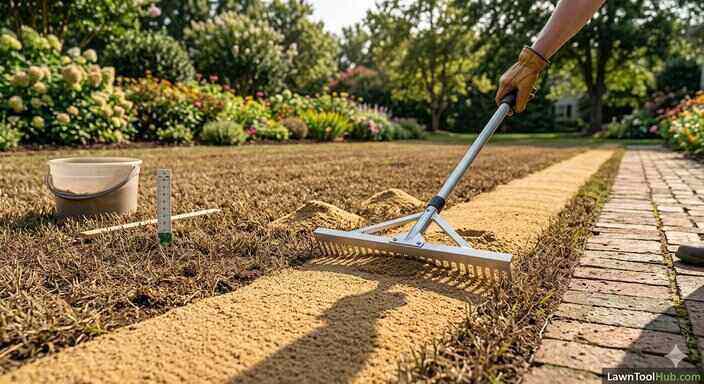
Few things match the satisfaction of a perfectly flat, golf-course-smooth lawn. If you own a Bermuda yard, you already possess the ideal turfgrass blueprint for achieving that putting-green look. But if your weekend plans involve spreading tons of masonry sand to fix those annoying dips and ankle-twisting potholes, you face a critical first step. Before you dump a single pile of topdressing onto your yard, you have to prepare the canopy. Every ambitious homeowner ends up asking the exact same question: how short should you mow Bermuda grass before leveling raking to ensure the sand actually reaches the soil profile instead of suffocating your turf?
When I’m out in the yard prepping for a major topdressing project, standard maintenance rules go completely out the window. To make room for your materials, you have to take the grass down significantly lower than your weekly trim. Getting your hands on a heavy-duty lawn leveling rake for sand topdressing bermuda lawns is only half the battle; the real magic happens in how aggressively you scalp the grass beforehand. Let’s break down the exact heights, timing, and step-by-step math required to safely drop your canopy without permanently damaging your lawn.
The Core Breakdown: Scalping Heights by Mower Type
To understand how short should you mow Bermuda grass before leveling raking, you have to look at the mechanical limitations of your cutting equipment. Trying to force a standard rotary mower down to golf-course heights in a single afternoon will scalp your lawn down to bare brown stems and potentially damage your machine’s crankshaft if you strike a hidden ridge.
| Mower Type Used | Daily Maintenance Height | Ideal Pre-Leveling Scalp Height | Actionable Strategy |
| Standard Rotary Mower | $1.5\text{ to }2.0\text{ inches}$ | $0.5\text{ to }0.75\text{ inches}$ | Drop down incrementally by one notch per mow over a single week. Set your deck to its absolute lowest or second-lowest setting on the final pass. |
| Manual or Powered Reel Mower | $0.5\text{ to }1.0\text{ inch}$ | $0.25\text{ to }0.375\text{ inches}$ | Take advantage of the roller system to slice the grass down to dirt level. This allows for an ultra-thin, precise sand layer. |
Why An Aggressive Scalp is Non-Negotiable
Bermuda grass is a resilient beast that thrives on aggressive low cutting, thanks to its extensive underground rhizome network. When you are determining exactly how short should you mow Bermuda grass before leveling raking, cutting it too high is actually a recipe for structural failure.
- Preventing the “Sponge” Effect: If you leave your Bermuda grass at $1.5\text{ inches}$ or taller, the sand won’t sift through the canopy. Instead, it balances on top of the grass blades, trapping the leaves underneath, blocking sunlight, and creating a muddy, rotting sponge that kills the turf.
- Maximized Rake Efficiency: A low cut allows the ground-facing flat bars of your leveling rake to glide smoothly along the actual soil surface. This lets you distribute sand precisely into low spots without getting hung up on thick, springy grass runners.
- Faster Recovery Times: Exposing the dirt directly to warm ambient sunlight triggers rapid lateral growth from Bermuda’s stolons, helping the grass burst through the new sand layer in half the time.
How to Prepare and Mow Your Bermuda Lawn for Leveling
Follow this strict chronological guide to safely drop your yard’s canopy down to the dirt without burning out your equipment or stalling your turf’s recovery window.
Step 1: Wait for Peak Summer Growth
Never scalp your lawn for a leveling project during early spring or autumn. Your Bermuda grass must be actively growing, completely green, and requiring mowing at least twice a week. This aggressive growth state ensures the turf has enough stored carbohydrate reserves to recover immediately from a severe cut.
Step 2: The Step-Down Scalping Process
Do not attempt to drop from $2\text{ inches}$ down to $0.5\text{ inches}$ in one single pass. This bogs down your mower engine and creates massive piles of thick debris that jam your discharge chute.
- Cut the lawn at your normal height.
- Drop the deck by one notch the following afternoon and mow again.
- Drop it to the absolute lowest setting on day three for the final scalp.
Step 3: Bag and Remove Every Single Clipping
While leaving clippings on the lawn is great for routine fertilizing, it is completely forbidden before leveling. Attach a collection bag to your mower or use a heavy-duty lawn vacuum to clear away all organic material. Any dead thatch left behind will mix with your leveling sand, creating an anaerobic layer that locks out oxygen.
Step 4: Run a Stiff Yard Broom or Power Rake
After your final low pass, use a stiff-bristled broom or a mechanical dethatcher to pull up low-lying, lateral stolons that are pressed flat against the dirt. Run your mower over the lawn one last time to clip these lifted runners away. The cleaner the dirt floor, the easier your sand will flow.
💡 Pro-Tip: The Moisture Check
Never spread your leveling sand on a damp lawn. Wet sand sticks to short grass blades like wet cement, making it nearly impossible to rake evenly. Wait for three consecutive dry, sunny days so your topdressing material sifts between the short stubble like dry hourglass sand.
Frequently Asked Questions
Will scalping my Bermuda grass this short kill the lawn?
No. While your yard will look completely brown, dry, and dead immediately after a deep scalp, you are simply exposing the woody stem system (stolons). As long as your lawn is healthy, watered properly, and actively growing in warm summer weather, fresh green blades will begin pushing through within 5 to 7 days.
What happens if I skip the scalp and level at my regular height?
If you try to rake sand into tall grass, the rake will pull and tear at the turf roots, ripping up healthy patches of your lawn. Additionally, the sand will bridge across the tall canopy, preventing you from accurately identifying where the actual low spots and dips are located.
Should I apply fertilizer right after mowing and leveling?
Wait until you see green shoots actively pushing through the sand layer before applying a high-nitrogen fertilizer. Putting down fertilizer on a freshly scalped, sand-covered lawn can cause salt burn on exposed plant crowns. Let the grass stabilize for a week, then push growth with water and nutrients.