
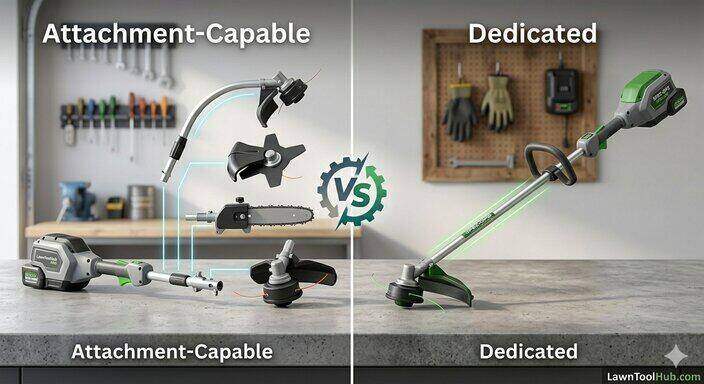
Choosing the right yard tools can feel like a high-stakes balancing act. Stroll down the outdoor power equipment aisle at any home improvement store, and you are immediately faced with a classic dilemma: do you buy an individual tool for every single task, or do you invest in a single modular power head that claims to do it all? When I’m out in the yard prepping for weekend maintenance, I want equipment that works hard without taking up every square inch of my garage shelves.
If you are currently weighing attachment-capable vs. dedicated string trimmers: pros and cons, the choice usually comes down to how much property you manage and how much patience you have for mechanical swap-outs. For a lot of homeowners, starting out with a commercial-grade gas powered weed eater with attachment capability makes perfect sense because it lays the foundation for an entire landscaping arsenal. But before you open your wallet, it is essential to understand exactly how these multi-head systems stack up against traditional, single-purpose machines in terms of weight, balance, long-term durability, and raw cutting power.
The Head-to-Head Breakdown: Deep-Dive Analysis
To give you an honest look at what you are paying for, let’s stack these two tool philosophies side-by-side. Both configurations have a definitive home in the lawn care world, but their performance profiles vary wildly under actual load.
| Performance Metric | Attachment-Capable Systems (Split-Shaft) | Dedicated String Trimmers (Solid-Shaft) |
| Tool Weight & Fatigue | Heavy power head; coupler adds noticeable front-heavy imbalance over long sessions. | Lightweight, perfectly balanced from the engine block to the cutting head. |
| Drive Shaft Construction | Uses a two-piece inner cable or square flex-shaft coupled together at the joint. | Single continuous solid steel or robust flex-shaft extending directly to the gear head. |
| Storage Footprint | Exceptional. Hangs vertically on a single wall bracket or tucks into a compact vehicle trunk. | Bulky. Requires long, dedicated racks to house multiple standalone tools. |
| Vibration Isolation | Moderate to high. The mechanical joint coupler inherently introduces subtle harmonic vibrations. | Low. Excellent anti-vibration rubber dampening isolates the operator’s hands from the engine. |
| Long-Term Operational Cost | Lower initial investment for adding tools, but a single engine failure sidelines your entire lineup. | Higher initial setup costs, but independent engine redundancies keep your crew working. |
Evaluating the Pros and Cons: Attachment-Capable vs. Dedicated String Trimmers
Understanding the structural design differences between these tools makes it much easier to predict how they will handle your specific yard conditions over the next five to ten years.
Attachment-Capable Systems (The Swiss Army Knife Approach)
These units feature a split-shaft design with a heavy-duty mechanical coupler located right in the middle of the aluminum tube. The engine or electric motor resides entirely at the top, and you can hot-swap the bottom half for an edger, pole saw, hedge trimmer, or cultivator.
- The Pros: The obvious winner here is cost and storage efficiency. Instead of buying four separate small gas engines—each requiring its own winterization, fuel stabilization, and carburetor maintenance—you maintain one single power head. If you need to trim an overgrown tree limb, you just click in the pole saw attachment and get to work.
- The Cons: Split-shaft tools are inherently heavier. The aluminum coupler adds dead weight right where you grip the tool, which can lead to premature forearm fatigue. More importantly, the internal drive shaft has to bridge a physical gap. Over years of hitting thick brush, that connection coupler can warp, round out, or slip, leading to a loss of spinning efficiency.
Dedicated String Trimmers (The Single-Purpose Thoroughbreds)
A dedicated trimmer features a solid, uncompromised shaft running directly from the clutch drum straight to the bottom bevel gear. It does one job, and it does it with absolute precision.
- The Pros: Balance and raw performance. Because engineers don’t have to account for a middle joint, they can balance the tool perfectly across your body. A dedicated solid-steel shaft transmits nearly 100% of the engine’s torque straight to the trimmer line without any energy loss or flex. If you are trimming thick weed fields or dense ditch banks for hours at a time, a dedicated machine feels lighter and smoother in the hands.
- The Cons: They are space hogs. If you eventually need an edger and a pole saw, you have to buy entirely separate standalone units. That means storing multiple long shafts on your garage wall and maintaining multiple engines or managing several different battery ecosystems.
How to Choose the Best Configuration for Your Property
If you are still on the fence about attachment-capable vs. dedicated string trimmers: pros and cons, follow this simple property-size blueprint to guide your purchasing decision.
When to Choose an Attachment-Capable System:
- You manage a standard suburban lot: If your yard requires 15 minutes of trimming, 10 minutes of edging, and occasional hedge shaping, a modular system is unbeatable.
- Your storage space is at a premium: If you live in a townhouse or maintain a neat garage without room for an entire fleet of landscaping equipment, the split-shaft design fits easily on a standard pegboard shelf.
- You want high-end commercial power on a budget: Buying one premium, commercial-grade power head plus three attachments is significantly cheaper than buying four independent entry-level tools.
When to Go with a Dedicated String Trimmer:
- You have large acreage or rural property: If you regularly spend two continuous hours clearing fence lines, the superior balance and lower vibration of a dedicated solid-shaft machine will save your back and shoulders from immense strain.
- You are running a commercial landscaping business: Crew members are notoriously tough on gear. A single-piece solid shaft can withstand being tossed into the back of a work truck day after day without worrying about dirt getting trapped inside a sensitive mid-shaft coupling joint.
- You prioritize maximum mechanical reliability: Dedicated units have fewer moving parts, which inherently translates to fewer failure points over the lifespan of the tool.
Safety and Mechanical Maintenance Tips for Split-Shaft Owners
If you decide to go the attachment-capable route, maintaining the coupling interface is critical to prevent the inner drive cables from snapping under load.
- Grease the Drive Core: Once every season, slide your attachments out of the coupler. Apply a small, dime-sized dab of high-quality lithium or molybdenum grease directly onto the squared-off metal end of the inner drive shaft before sliding it back into the power head. This dramatically reduces friction heat inside the joint.
- Clear Dirt Before Coupling: Never let the open ends of your attachments sit directly in the dirt or sand while changing tools on your driveway. Fine grit getting trapped inside the female receptacle of the coupler acts like sandpaper, wearing down the tight tolerances and causing the tool to wobble during high-speed rotation.
- Secure the Tightening Knob Fully: Always ensure the alignment pin clicks perfectly into its designated tracking hole before clamping down the thumb screw or lever lock. Running the tool with a loose coupler will quickly strip out the internal drive splines, destroying both the power head and your attachment shaft.