
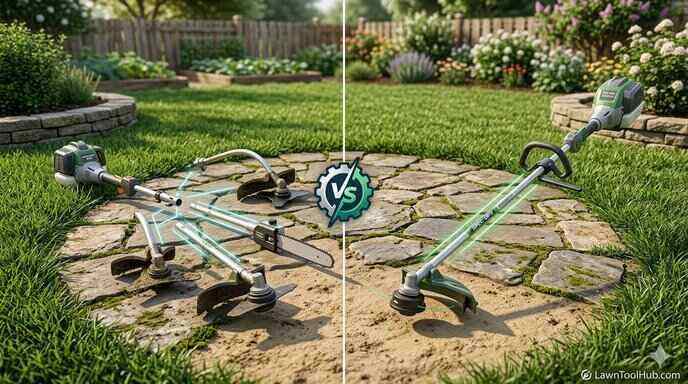
There is something deeply satisfying about looking out over your yard and seeing a crisp, laser-straight edge running perfectly along your sidewalk and driveway. It takes a property from looking “just mowed” to looking like a high-end golf course. When I’m out in the yard on a clear Saturday morning, crisping up those borders is easily my favorite task. But if you are a new homeowner standing in the tool aisle for the first time, you are likely staring down a tough choice. Specifically, when looking at gas vs. battery edgers: which is easier to maintain for beginners? The tool you pick dictates how much time you will spend actually working on the machine instead of working on your lawn. If you want to skip the mechanical headaches entirely, choosing a lightweight battery powered edger for beginners allows you to focus on mastering your steering technique rather than troubleshooting a finicky engine. Let’s separate the marketing myths from real-world garage reality to see exactly what kind of regular upkeep both options demand.
Myth vs. Fact: Uncovering the Reality of Small Engine Upkeep
If you chat with old-school commercial landscapers, they will tell you that gas is the only way to go. But what works for a crew running tools eight hours a day doesn’t always make sense for a beginner’s suburban garage. Let’s debunk a few common assumptions about tool maintenance.
Myth 1: “Gas edgers only need fuel to keep running indefinitely.”
- The Fact: Gas engines are complex mechanical systems. A standard 2-stroke or 4-stroke gas edger requires a strict upkeep schedule. You have to mix fuel stabilizers, clean or replace spark plugs, clear clogged air filters, and rebuild gummed-up carburetors. If you let raw pump gas sit in the tank for more than 30 days, the ethanol will attract moisture, varnish the interior fuel lines, and leave you with a machine that refuses to start next spring.
Myth 2: “Cordless battery edgers are completely maintenance-free.”
- The Fact: While cordless options eliminate engine hassles, they are not zero-work tools. You still have to manage lithium-ion battery health, keep the debris guard clean, and monitor the gear head assembly. However, the nature of the work shifts from messy mechanical repairs to simple, clean physical inspections.
Read More: How Much Does a Lightweight Electric Lawn Edger Weigh?
Gas vs. Battery Edgers: Which is Easier to Maintain for Beginners? (The True Cost of Time)
To see how these power sources stack up over a typical landscaping season, let’s look at the actual chore list required to keep each machine operating at peak performance.
| Upkeep Category | Traditional Gas-Powered Edgers | Modern Cordless Battery Edgers |
| Pre-Start Prep Time | High. Must mix 2-cycle oil with fresh gas or check the oil reservoir level. | Zero. Snap a fully charged lithium-ion pack into the battery cradle. |
| Fuel / Energy Storage | Difficult. Requires ventilated fuel cans; gas degrades rapidly. | Simple. Keep batteries indoors on a shelf out of extreme heat or freezing cold. |
| Winterization Protocol | High. Must drain the fuel tank completely or run the carburetor dry. | Low. Bring the battery packs inside the house and leave them at 50% charge. |
| Component Replacement | Spark plugs, fuel filters, primer bulbs, and air filters. | Edger blades, guard skirts, and occasional gear head grease. |
Practical FAQ: Everything New Homeowners Need to Know
What happens if I hit a rock with a gas edger vs. a battery edger?
When a gas edger hits a buried rock or a thick tree root, the heavy internal flywheel keeps forcing the steel blade forward. This can cause a violent kickback that jolts your arms, and if the impact is severe enough, it can bend the engine’s crankshaft.
If you strike a rock with a battery edger, the electronic speed controllers instantly detect the sudden spike in electrical resistance. The smart system automatically trips an internal circuit breaker, cutting power to the brushless motor in milliseconds to prevent physical damage to the gears.
How do I store cordless lawn tools during the off-season?
Battery storage is incredibly easy, but it requires protecting the chemical cells inside the pack. Never leave your lithium-ion batteries sitting in an unheated garage or shed over a freezing winter. Bring them inside a climate-controlled space like a closet or basement. For long-term storage, leave the batteries filled to roughly 40% to 60% capacity rather than storing them completely dead or 100% full.
Does a battery edger have enough power for thick turf?
In the past, battery tools struggled against aggressive, creeping warm-season grasses like Bermuda or St. Augustine. However, modern high-voltage platforms ($40\text{V}$ to $60\text{V}$) combined with brushless motors provide identical rotational torque to small gas engines. As long as you keep a sharp blade on the tool, it will slice through dense roots without bogging down.
How often do I need to grease the edger’s gear head?
For most beginner battery-powered models, the gear case is completely sealed at the factory and requires no regular lubrication. For heavy-duty or commercial-grade cordless units, there is a small hex bolt on the side of the lower gear housing. Pop that bolt off once every season and squeeze in a pea-sized amount of high-quality lithium grease to keep the internal bevel gears spinning smoothly.
The Ultimate Verdict for Beginners
When analyzing gas vs. battery edgers: which is easier to maintain for beginners, the clear winner for anyone starting out is battery power.
Gas edgers are phenomenal tools if you need to run them continuously across massive acreage without waiting on a battery charger. But for a standard residential lot, the hidden cost of gas tool ownership is the time spent wrenching on the engine. Cordless battery systems swap out greasy mechanics for a simple push-button start, allowing you to spend your weekend enjoying a beautifully manicured lawn rather than pulling a starter cord on a flooded carburetor.