
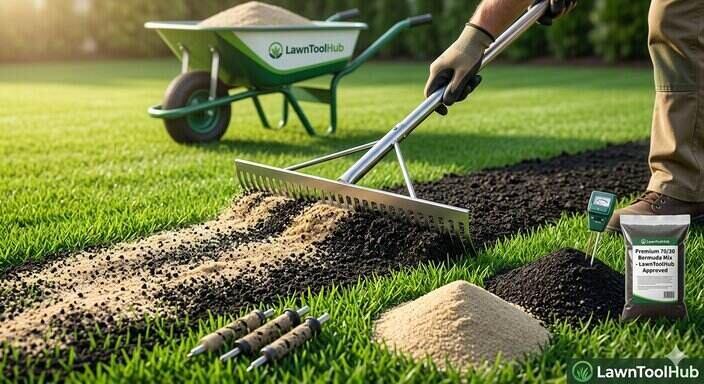
If you have ever stepped in a sudden dip while walking across your lawn or watched your lawnmower scalp a high spot down to the dirt, you know exactly how frustrating an uneven lawn can be. Bermuda grass loves to be mowed low—golf course low—but achieving that smooth, carpet-like look requires a perfectly flat surface. To get those results, you need to apply a topdressing material that fills the low spots without choking out the root system. Finding what is the Best Sand Mixture for Leveling Bermuda Grass is the absolute secret weapon to removing the bumps, improving drainage, and creating a lawn that makes your neighbors stop and stare.
When I’m out in the yard prepping for a leveling project, I always emphasize that the tools you use matter just as much as the soil blend itself. Pushing a heavy, wet mixture into dense turf requires a tool designed to let the grass blades slip through while leaving the leveling mix exactly where it belongs. Investing in the Best heavy duty lawn leveling rake for topdressing Bermuda grass turns a grueling day of manual labor into a highly efficient, satisfying project that ensures perfectly flat results. However, long before you start dragging a rake across your yard, you have to nail down the exact breakdown of your topdressing material. Let’s look at the science of soil textures to see which options actually work and which ones will ruin your lawn’s structure.
The Breakdown: Comparing Topdressing Leveling Materials
Choosing the right material isn’t just about grabbing whatever bag is cheapest at the local big-box store. Bermuda grass thrives in well-draining, highly porous root zones. If you drop the wrong soil texture onto your lawn, you risk creating a hard, compacted layer that restricts oxygen, water, and vital nutrients from reaching the roots.
The table below breaks down the primary options used by homeowners and professionals alike:
| Material Blend | Best Used For | Pros | Cons |
| 100% Masonry Sand | Golf-course level smoothness; fixing minor ripples ($< 1/2$ inch deep). | Sifts into dense turf effortlessly; doesn’t compact; zero weed seeds. | Provides no nutritional value; dries out quickly in extreme heat. |
| 70/30 Blend (Sand to Organic Compost) | General residential leveling; deep depressions ($1/2$ to 2 inches deep). | Balanced drainage; introduces vital organic matter and micro-nutrients. | Can contain random weed seeds; compost degrades over time, causing minor settling. |
| 50/50 Topsoil and Sand | Major lawn renovations; filling massive sinkholes and ruts. | Holds moisture well; closely matches native clay or loam soil profiles. | Heavy to push; harder to sift down past thick Bermuda stolons; prone to compaction. |
Why Sand is the Ultimate Base for Bermuda Turf
You might wonder why golf courses and high-end residential lawns rely so heavily on coarse sand rather than pure black topsoil. The answer comes down to structural permanence. Organic matter like compost, peat moss, and manure decays over time. If you fill a one-inch hole with pure compost, it will look flat for a few months, but as the organic material breaks down, the hole will simply reappear. Sand particles do not decompose. Once sand settles into a low spot, it stays there permanently, providing a stable matrix that Bermuda roots and aggressive stolons can easily punch through.
How to Apply the Best Sand Mixture for Leveling Bermuda Grass Like a Pro
Now that you understand the material science, let’s walk through the actual step-by-step process of preparing your yard and executing the application without burying your grass alive.
Step 1: Scalp, Bag, and Core Aerate
Never try to level a lawn that is overgrown or shaggy. Two weeks before your project, apply a quick-release nitrogen fertilizer to get the Bermuda actively growing and aggressive. On the day of the project, drop your mower down to its lowest possible setting—safely scalping the lawn to remove the canopy. Bag all the clippings to leave the bare soil exposed. If your lawn feels hard as concrete, run a core aerator over the yard first. Pulling up plugs creates room for the sand to migrate into the existing soil profile, preventing a harsh layer change.
Step 2: Ensure the Lawn and Materials are Bone-Dry
This is the golden rule of leveling. Trying to spread wet sand is an absolute nightmare. It clumps up, sticks to the grass blades, and turns into a heavy paste that defies easy leveling. Wait for a clear, sunny weekend. Dump your sand or sand-compost mixture into small, evenly spaced piles across the lawn, and let the sun dry out the exterior layer for a few hours before you touch it.
Step 3: Distribute and Rake Diagonally
Shovel the dry leveling mixture into the low spots. Grab your heavy-duty leveling rake and work in a slow, cross-hatch, diagonal pattern across the lawn. Avoid pushing down hard on the tool; let the weight of the metal ground plate glide smoothly across the high points of the turf. The sand will naturally drop off the plate and settle directly into the low pockets while the tips of the green Bermuda blades spring back up through the mesh.
Step 4: Water Deeply and Stay Off the Lawn
Once the material is perfectly level and the grass tips are cleanly peeking through, turn on your sprinklers. Give the lawn a deep, thorough watering to wash the sand grains off the foliage and lock the mixture firmly into the soil base. Keep foot traffic, pets, and heavy lawnmowers off the lawn for at least a week to let the Bermuda stolons aggressively run across the fresh sand and knit the surface together.
By selecting a clean, coarse masonry sand or a premium 70/30 compost blend, you give your Bermuda turf the perfect physical environment to spread. Pair that ideal mix with a dedicated leveling tool, and you’ll achieve a smooth, perfectly flat lawn that stays level for years to come.
