
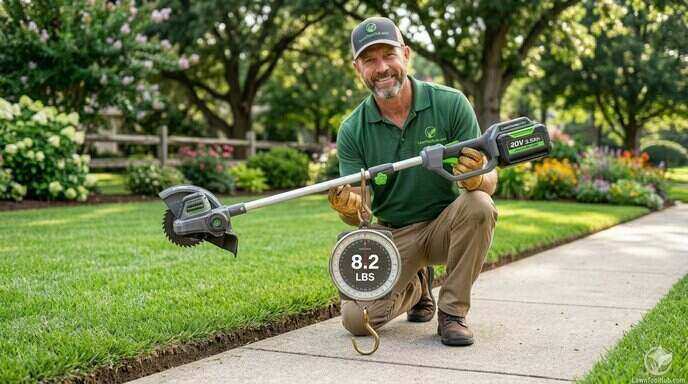
There is nothing quite like looking down your driveway and seeing a crisp, laser-straight edge separating the concrete from a thick, green bed of grass. It completely transforms your home’s curb appeal. When I’m out in the yard on a clear Saturday morning, dropping my edger into the turf groove is easily my favorite finishing step. But if you have spent years wrestling with heavy, vibration-heavy gas equipment, you know how quickly upper-body fatigue can turn a fun chore into a grueling workout. If you are shopping for a tool that won’t ruin your back or shoulders, you are likely asking a very practical question: how much does a lightweight electric lawn edger weigh, and can it still handle tough turf?
The short answer is that the lightweight electric class has come a long way from the clunky, unyielding tools of the past. If you are hunting for an ergonomic lawn edger for a smaller frame or simply want something you can easily lift with one hand, modern design has dropped the physical mass of these tools significantly. However, a tool’s overall weight isn’t a single, flat number. It varies wildly depending on whether you choose a plug-in corded model or a lithium-ion battery setup. Let’s look at the actual physics behind these numbers, look at the physical trade-offs of each power configuration, and establish exactly what you should expect before heading to the checkout counter.
The Weight Spectrum: Corded vs. Battery Platforms
To truly answer the question of how much does a lightweight electric lawn edger weigh, we have to break the category down into its two distinct mechanical designs: corded AC models and cordless DC battery units.
Corded Electric Edgers (The Absolute Lightweights)
If your primary goal is minimizing pure physical heft, corded models are the undefeated champions. Because these tools draw their current directly from your home’s wall outlet via an extension cord, they do not require a heavy onboard fuel source or chemical cells.
- The Average Weight: Expect a corded, dedicated electric edger to weigh between 6.5 to 9 pounds total.
- The Physics: Holding a 7-pound tool feels completely effortless for most homeowners. The brushless or brushed electric motors inside these units are remarkably compact, distributing what little weight they have directly over the wheel axle.
Cordless Battery Edgers (The High-Mobility Middleground)
Cordless battery tools offer complete freedom of movement without the hassle of a trailing extension cord, but they carry a physical weight penalty. When evaluating a battery machine, you always have to consider the “bare tool” weight versus its total operational weight with the battery clicked into the cradle.
- The Average Weight: A bare tool usually clocks in around 7.5 to 9.5 pounds. However, once you slide in a standard $40\text{V}$ or $56\text{V}$ lithium-ion battery pack, the total operational weight lands between 11 to 14 pounds.
- The Physics: While 12 pounds is significantly lighter than a 20-pound commercial gas unit, the rear-heavy placement of a large battery pack can alter the tool’s natural balance.
Read More: How to Unclog a Manual Core Aerator Stuck with Clay Soil
Deep-Dive Analytical Weight Breakdown by Component
To understand where the ounces are being shaved off—and how it affects tool tracking and durability—let’s look at a structural comparison of typical modern components.
| Edger Component Material | Estimated Weight Impact | Impact on User Ergonomics & Maneuverability |
| Aluminum Telescoping Shaft | Minimal (1.5 to 2 lbs) | Excellent. Reduces total shaft flex while keeping the center of gravity low. |
| Stamped Steel 7.5-Inch Blade | Moderate (0.8 to 1.2 lbs) | High centrifugal mass provides inertia to slice tough clay, but adds nose-weight. |
| $20\text{V}$ / 2.5 Ah Slim Battery | Low (1.1 to 1.5 lbs) | Perfect for short sessions; keeps total tool weight under 10 lbs but limits runtime. |
| $56\text{V}$ / 5.0 Ah Heavy-Duty Battery | High (4.5 to 5.2 lbs) | Offers professional-grade runtime but shifts the balance significantly to the rear handle. |
How to Check and Optimize a Lightweight Edger for Your Body
If you want to maximize a lighter tool’s efficiency, you shouldn’t just look at the raw number on the box. You need to adjust the machine’s geometry to work with your body’s natural lever systems. Here is exactly how to set up your electric unit to avoid muscle strain.
1. Let the Guide Wheel Take 90% of the Mass
In my experience, the biggest mistake people make with lightweight edgers is holding them suspended in mid-air like a string trimmer. Even a tiny 7-pound tool will cause intense forearm fatigue if you carry its entire weight using muscle power alone.
- The Technique: Drop the tool down so its dedicated guide wheel rests completely flat on your concrete sidewalk or driveway curb. The wheel acts as a mechanical fulcrum. Let the concrete carry the entire tool weight; your arms should only apply a gentle, horizontal pushing force to guide it forward.
2. Fine-Tune the Auxiliary D-Handle
Most high-quality lightweight electric edgers feature an adjustable loop handle on the upper shaft. If this handle is clamped too high or too low, it forces your lower back into an awkward, asymmetrical twist while you work.
- The Adjustment: Stand completely straight with your shoulders back and arms hanging relaxed. Loosen the wing nut on the auxiliary handle and slide it to the exact point where your non-dominant hand grips it naturally with a soft, 45-degree bend at the elbow. This evenly distributes steering control across your chest muscles instead of overloading your lower back.
3. Account for Cord Drag Physics
If you choose a ultra-light corded model weighing 7 pounds, remember that pulling 100 feet of heavy-duty, 12-gauge outdoor extension cord through dense turf adds significant resistance.
- The Hack: Loop the extension cord through the cord-retention hook built into the rear handle of the tool, then wear the cord over your shoulder like a sash. This keeps the trailing weight anchored closer to your body’s center of mass, preventing the cord from constantly tugging at your wrists as you push down the sidewalk line.
4. Maintain a Clean Underside to Prevent “Weight Creep”
As you edge along damp soil and dew-covered grass, a thick, heavy slurry of mud and shredded root pulp packs tightly inside the protective plastic blade guard. Over a single long afternoon, this caked-on debris can add up to 2 pounds of dead weight directly to the nose of your tool.
- The Maintenance: After every yard session, pop the battery out or unplug the cord. Flip the unit over and use a plastic putty knife to scrape out the internal guard walls. Keeping this cavity clear keeps your tool running at its factory-engineered weight profile and stops parasitic drag from draining your battery life.