
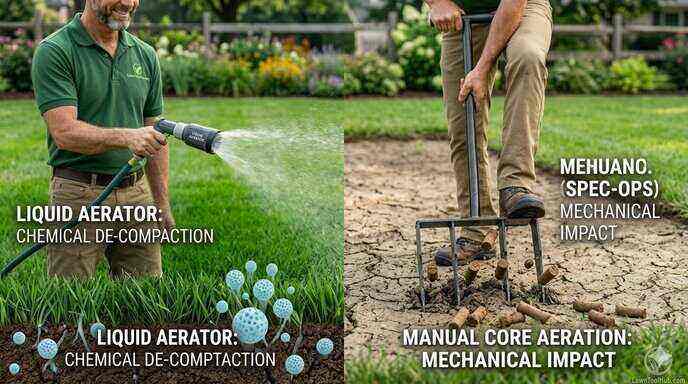
There is nothing quite like looking across the fence and seeing a thick, dark green carpet of turf that bounces slightly when you walk on it. It’s the ultimate backyard goal. But if your property was built on a heavy, compacted foundation, achieving that dream yard feels like an uphill battle against solid brick. When I’m out in the yard prepping my turf for the summer heat, dealing with compaction is my absolute top priority. If your roots are suffocating, you have likely run into a massive debate online: liquid aerator vs. manual core aeration for hard clay soil.
Choosing between these two approaches depends entirely on how much elbow grease you want to put in and how quickly your soil needs to breathe. If you are leaning toward the mechanical route, using a heavy-duty hand aerator for breaking up clay lawn compaction gives you instant, undeniable physical openings that let water and oxygen dive straight to the root zone. However, liquid chemical alternatives promise to loosen things up with a simple garden hose attachment. Let’s dig into the actual soil science, compare the data head-to-head, and look at exactly which method deserves a spot in your weekend routine.
Liquid Aerator vs. Manual Core Aeration for Hard Clay Soil: The Deep-Dive Analysis
To understand why one method might triumph over the other on your specific property, we have to look at the physics and chemistry of how they interact with compressed dirt. They do not accomplish the same task; they attack compaction from two entirely different angles.
Mechanical Action vs. Chemical Dispersal
Manual core aeration is a mechanical process. You step on a steel tool, and the hollow tines physically extract cylindrical plugs of dirt out of the earth. This immediately removes physical mass from the ground, leaving behind clear, open cavities where the surrounding soil plates can expand into the newly created space.
Liquid aerators work on a microscopic, chemical level. They do not contain magical subterranean tunneling bugs. Instead, they are primarily formulated with heavy-duty surfactants (wetting agents like ammonium lauryl sulfate) or advanced organic polymers. When sprayed over the turf, these chemicals break down the surface tension of the water, allowing it to penetrate deeply into tiny soil pores. Once inside, the polymers help group ultra-fine clay platelets together into larger aggregates, creating larger structural voids.
Head-to-Head Breakdown: Performance Indicators
| Comparison Factor | Liquid Chemical Aerator | Manual Mechanical Core Aerating |
| Speed of Visible Results | Slow. Takes multiple applications over several months to alter structure. | Instant. Physical holes are open and active the moment you lift the tool. |
| Physical Effort Required | Minimal. Screw the bottle onto your garden hose and spray the grass. | High. Requires steady foot power and a solid workout to cover the lawn. |
| Ideal Soil Condition | Mild to moderate compaction; great as a preventative maintenance spray. | Severe Compaction. Essential for rock-hard “baker’s clay” basements. |
| Equipment Cost | Low recurring cost per bottle ($25 – $40 per application). | One-time investment for a lifetime steel hand tool ($35 – $60). |
| Ancillary Benefits | Increases water absorption and eliminates surface runoff. | Perfect prep channel for deep fall overseeding and compost top-dressing. |
How to Execute the Ultimate Aeration Strategy for Heavy Clay
In my experience, you don’t actually have to pick a single side in the liquid aerator vs. manual core aeration for hard clay soil showdown. The absolute best lawns on the block use a combination of both to transform bad dirt into premium topsoil. Here is the step-by-step process to execute this combined attack safely and efficiently.
Step 1: The Pre-Watering Window
Never attempt to drive a manual hand tool into bone-dry, summer-baked clay. You will end up with a bent step-bar or a pulled shoulder muscle.
- Run your lawn sprinklers for roughly 20 to 30 minutes exactly 24 to 48 hours before you plan to aerate.
- This allows moisture to seep down 3 inches, softening the clay matrix into a workable, pliable state while letting the top blade canopy dry out enough to prevent slipping.
Step 2: Pull the Physical Cores
Take your manual hand tool and systematically cover your high-traffic compacted zones—like the pathways along your walkways or where children and pets run.
- Step firmly on the footbar, driving the hollow tines entirely into the ground.
- Space your plunges roughly 4 to 6 inches apart.
- Leave the extracted soil cylinders lying directly on top of the turf. They will break down naturally over the next few rain cycles, releasing helpful micro-organisms back into your thatch layer.
Step 3: Follow Up with the Liquid Surfactant
Once your lawn is filled with open, mechanical core holes, it is the perfect moment to deploy your liquid aerator spray.
- Mix or attach your liquid tool according to the manufacturer’s dilution guide.
- Spray the entire lawn evenly. Because you have physically punctured the ground, the liquid surfactant won’t just sit on the top surface—it will run down inside the open 3-inch core walls, expanding its structural benefits deep into the subsoil layers.
Step 4: Top-Dress and Lock in the Micro-Voids
To ensure your clay walls don’t simply collapse back together and re-compact after a heavy rain storm, sweep a very thin quarter-inch layer of finely screened organic leaf compost or coarse masonry sand over the yard. The material will drop straight down into the holes, creating permanent, porous pathways that lock in long-term drainage for the rest of the growing season.
Critical Safety and Tool Maintenance Rules
Whether you choose a liquid bottle or a steel step-tool, operating on heavy clay requires a few hands-on rules to protect your equipment and your body:
- Locate Your Utilities First: Before driving steel tines into the ground near your property boundaries, always verify the location of shallow lines. Irrigation pipes, low-voltage landscape lighting wires, and fiber-optic internet lines are often buried only an inch or two beneath the sod line.
- Clear Core Clogs Instantly: If your manual tines stop extracting plugs and start acting like flat stakes, they are clogged with a vacuum-sealed clay slug. Keep a large carriage bolt in your pocket to push the obstructions backward out of the top cylinder before making your next pass.
- Store Chemicals Safely: Liquid aerators are highly concentrated surfactants. Keep bottles sealed tightly in a climate-controlled garage shelf out of direct sunlight to prevent the polymers from breaking down prematurely during hot summer months.