
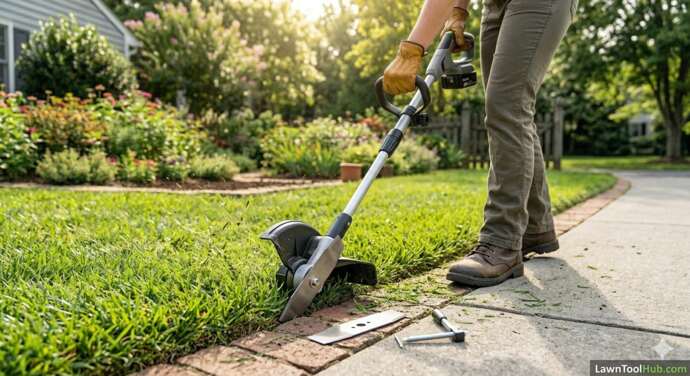
There is nothing quite like looking across a freshly mowed yard and seeing a razor-sharp, crisp line separating your lush green turf from the concrete driveway. It completely changes the look of your entire property. When I’m out in the yard on a sunny weekend afternoon, my favorite tool to reach for is a battery-powered edger. It is quiet, lightweight, and incredibly convenient. If you are using a premium cordless bladed edger for clean lawn borders, you already know how much easier it makes your weekly maintenance routine compared to wrestling with an old gas-guzzling machine.
But over time, you will inevitably notice that your clean lines start looking a little ragged and frayed. The machine might start bogging down or vibrating heavily in your hands. This leaves every dedicated property owner asking the exact same question: how long do cordless lawn edger blades last, and what can you do to squeeze every single bit of life out of your cutting steel? Let’s dive straight into the numbers, debunk a few common misconceptions, and look at the real-world factors that determine your blade’s expiration date.
Myth vs. Fact: Debunking Edger Blade Lifespans
There is a ton of misinformation floating around online forums regarding tool maintenance. Let’s separate the actual field experience from the backyard myths.
- Myth: All steel edger blades are created equal, so buying the cheapest multi-pack is always the smartest move.
- Fact: Carbon steel quality varies wildly. High-carbon, heat-treated steel blades resist bending and abrasive soil wear significantly longer than cheap, unhardened steel replacements.
- Myth: You should sharpen your edger blades once a month to keep them performing like new.
- Fact: Unlike lawn mower blades, which slice through delicate grass blades, an edger blade relies on speed and mass to fracture soil and root structures. Sharpening an edger blade down to a knife-like edge actually thins out the metal, causing it to wear away or chip twice as fast when it strikes concrete.
- Myth: A cordless edger blade lasts just as long as a heavy-duty commercial gas edger blade.
- Fact: Because battery-powered units operate at slightly lower torque peaks than massive gas engines, operators often accidentally drag or force the blade through the dirt slower, which can alter the friction profile and accelerate wear if your technique isn’t dialed in.
Read More: Can You Sharpen a Cordless Lawn Edger Blade?
The Real Numbers: Expected Lifespan Breakdown
In my experience, there is no single “magic number” because every yard possesses a unique soil footprint. However, we can map out highly accurate estimates based on typical residential usage patterns and soil profiles.
Standard Suburb Soil (Sandy Loam / Moderate St. Augustine or Bermuda)
If your property features loose, forgiving soil and you maintain your edges weekly, a standard $8$-inch heavy-duty blade will generally last between 15 to 30 total uses. For an average property owner, that translates to roughly one full landscaping season before the steel rounds down significantly.
Bumpy, Compacted Clay or Rocky Terrain
If your turf grows in thick, abrasive clay or you are constantly scraping against buried limestone chunks, your blade life will drop dramatically. In these brutal conditions, expect a blade to last roughly 5 to 10 uses before it loses its structural width and efficiency.
Establishing a Brand-New Edge (The First Cut)
Establishing a pristine boundary where soil and overgrowth have completely swallowed a sidewalk is the ultimate blade-killing task. Slicing through years of compacted dirt and thick roots will often destroy a fresh blade in a single afternoon. Once that trench is established, though, subsequent maintenance passes require a fraction of the effort.
4 Crucial Factors That Dictate Your Blade’s Lifespan
Understanding how long do cordless lawn edger blades last requires looking at how your specific yard and operating style impact the tool’s metallurgy.
1. Concrete Contact Frequency
The absolute fastest way to incinerate an edger blade is dragging it directly against the side of your concrete sidewalk. Steel against cured concrete creates intense friction and thermal heat, wearing down the tip of the blade like a spinning grinding wheel.
2. Battery Voltage and Motor Efficiency
A $20\text{V}$ compact cordless tool has to work significantly harder than a high-output $56\text{V}$ or $60\text{V}$ brushless model. When a motor lacks torque, the blade spins slower and catches on thick root masses. This causes the motor to bog down, creating uneven friction that warps and fatigues the metal.
3. Soil Compaction and Composition
Sand is highly abrasive. If you live in a coastal area with sandy soil, the high-speed spinning action acts like a literal sandblaster against the flat sides of your cutting steel, thinning out the blade profile until it becomes brittle.
Step-by-Step Maintenance Guide: How to Swap and Inspect Your Blade Safely
To ensure you are getting maximum utility while protecting your cordless tool’s electric motor, follow this quick inspection and replacement routine.
Step 1: Isolate the Power Source
Safety first—never work on a cutting deck with a live circuit. Press the battery release latch and completely slide the battery pack out of the tool housing before touching the guard assembly.
Step 2: Clean and Inspect the Guard Cavity
Thoroughly scrape away packed mud, root fiber, and decaying grass clippings from the inside of the blade guard. Accumulated debris restricts airflow, forcing your cordless motor to draw more battery current and reducing rotational speed.
Step 3: Check the Wear Indicator Marks
Examine the width of your blade. Most high-quality modern edger blades feature built-in small holes or notch lines near the center. If the outer edge of the steel has worn down past these safety indicators, or if the blade has lost more than $1\text{ inch}$ of its original diameter, it is time to discard it.
Step 4: Lock the Spindle and Loosen the Flange Nut
Insert your tool’s included holding pin or a small hex wrench into the spindle locking hole to keep the motor shaft from spinning. Use a socket wrench to turn the arbor nut clockwise (most edger spindles feature reverse, left-handed threads to prevent the nut from spinning off during operation).
Step 5: Seat the New Blade and Torque Securely
Slide off the outer support washer, discard the old blade, and place the fresh steel flush onto the inner flange. Ensure the blade is perfectly centered on the arbor ridge to avoid severe, tool-destroying wobbling. Reinstall the outer washer and tighten the nut securely counter-clockwise.
Frequently Asked Questions
Can I flip my edger blade around to extend its usable life?
Yes! If your blade doesn’t feature an explicit, unidirectional directional arrow stamped on the face, you can absolutely flip it 180 degrees. Flipping the blade allows the opposite side of the cutting edges to engage the turf, effectively doubling your runtime before you need to purchase a replacement.
What are the dangers of operating with a severely worn edger blade?
When a blade shrinks in diameter, you are forced to plunge the entire tool head much lower to the ground to reach the bottom of your edge line. This places your expensive motor housing, plastic guards, and shaft bearings in direct contact with dirt, rocks, and flying debris, risking expensive structural damage to the tool.
Should I choose a star-shaped or a standard rectangular blade for my cordless edger?
For cordless models, stick with classic rectangular blades. Star-shaped, multi-toothed blades offer excellent cutting power on commercial gas gear, but their extra surface area increases wind resistance and soil friction, which drains your cordless lithium-ion batteries significantly faster.
