
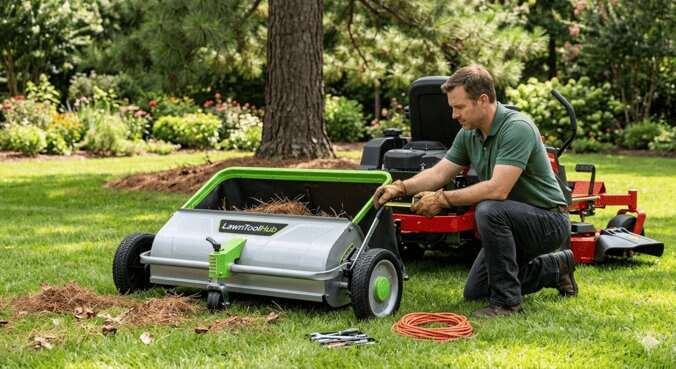
If you have a couple of large pine trees on your property, you know that dropping needles aren’t just a seasonal cosmetic issue. They knit together, form a thick mat, block sunlight, and smother your turf roots faster than regular tree leaves. When I’m out in the yard dealing with a fresh layer of needles, a rake is the absolute last tool I want to pick up. A mechanical sweeper is a massive lifesaver, but only if it’s calibrated correctly. If your settings are off by even a half-inch, you will either skim right over the needles or dig the brushes deep into the dirt, locking up the wheels. Mastering how to adjust your lawn sweeper height for maximum pine straw pick up will completely transform how you clean up your yard.
Getting your machine perfectly dialed in requires matching your specific equipment to the density of the debris. Whether you are operating a tow behind or push sweeper for pine straw, the core physics of brush-to-lawn contact remain exactly the same. Setting the height too low places massive structural strain on the drive gears, while setting it too high simply wastes your time. Let’s walk through a breakdown of what happens when adjustments go wrong, and examine a step-by-step framework to get your machine running flawlessly.
The Danger Zones: What Happens When Height Calibration Fails
Before we look at the ideal setting sequence, it helps to understand how a lawn sweeper responds to incorrect clearance heights. Pine straw is uniquely slick and flexible, meaning it behaves very differently than crisp autumn leaves.
The “Too Low” Trap (The Wheel-Slip Problem)
Many homeowners assume that slamming the sweeper down to its lowest setting will give them a pristine, vacuum-like finish. This is a critical mistake. When the sweeping brushes are forced too deep into the grass canopy or thatch layer, the resistance becomes greater than the friction of the wheels against the ground. The internal plastic or metal drive gears lock up, and the wheels simply slide across your grass without spinning the brushes. This grinds flat spots onto your rubber or plastic tires and can permanently strip out the internal gear teeth.
The “Too High” Trap (The Needle-Skimming Problem)
Because pine needles are thin and often weave themselves horizontally between grass blades, setting the brushes even slightly too high means the bristles will only tickle the very tips of the straw. You will end up driving over the same patch of lawn four or five times just to collect a handful of debris, defeating the entire purpose of owning a mechanical sweeper.
Step-by-Step: How to Adjust Your Lawn Sweeper Height for Maximum Pine Straw Pick Up
To get your sweeper calibrated perfectly on the first try, use this sequential setup method next time you haul the machine out of storage.
Step 1: Park on a Flat, Hard Surface First
Do not attempt to set your initial height while standing in thick grass. Park your sweeper on your driveway, sidewalk, or garage floor. This establishes a true “baseline zero” where the wheels and the bottom frame of the machine sit perfectly level.
Step 2: Measure the Initial Bristle Clearance
Locate your sweeper’s adjustment lever or knob (usually mounted on the front drawbar or main axle assembly). Look down at the rotating brushes. Adjust the height lever until the tips of the plastic bristles are suspended exactly $0.5\text{ inches}$ above the pavement. This $0.5\text{-inch}$ point is your benchmark starting height for a standard, healthy lawn canopy.
Step 3: Transition to the Grass and Check the Canopy Penetration
Roll the sweeper onto your grass. On an established lawn, the wheels will sink slightly into the soft thatch, while the grass blades will push upward against the brush housing. For pine straw, you want the bristles to penetrate the grass blades no deeper than $0.5$ to $1\text{ inch}$ into the turf canopy. The bristles should brush the top layer of thatch where the needles rest, without scraping the actual dirt surface.
Step 4: Conduct a 10-Foot Test Pass
Engage your towing vehicle or push the unit forward at a normal, steady walking speed ($3$ to $4\text{ mph}$ if towing). Watch the wheels closely. If the wheels spin smoothly and a clean path opens up in the pine straw behind you, your height is perfect. If the wheels drag or skip, pop the adjustment lever up by exactly one notch to relieve the pressure.
Core Equipment Comparison: Tow-Behind vs. Push Sweepers
| Feature/Metric | Tow-Behind Sweepers (42″−52″) | Push Sweepers (21″−26″) |
| Best For | Large acreage, long driveways, thick pine mats | Tight corners, gated yards, light spot-cleaning |
| Height Sensitivity | Medium (Hitch height affects brush angle) | High (Handlebar angle alters ground clearance) |
| Traction on Pine Straw | Excellent (Heavier frame presses wheels down) | Moderate (Requires steady forward operator weight) |
Essential Safety and Gear Maintenance Tips
- Clean the Axle Index Plates: Pine needles love to wrap around the wheel axles and jam into the height adjustment notches. Once a month, drop the sweeper on its side, clear out wrapped pine straw, and spray the height-adjustment spring pins with a dry silicone lubricant.
- Match Hitch Height to Vehicle: If using a tow-behind model, ensure your tractor hitch keeps the sweeper drawbar completely parallel to the ground. If the front of the sweeper tilts downward, the brushes will dig unevenly even if your height lever is set correctly.
- Avoid Wet Pine Straw: Wet needles stick to the soil and form an incredibly heavy mat. Sweeping wet pine straw doubles the physical weight inside your hopper and places immense strain on the brush shafts. Always wait for a dry, sunny afternoon.
Frequently Asked Questions
Why does my sweeper skip over pine straw on uneven terrain?
When you transition over bumps, slopes, or swales, the sweeper frame tilts, raising one side of the brushes away from the ground. If your yard has bumpy terrain, raise the height setting by one notch above standard and make two overlapping passes from different angles rather than trying to clear it all in one deep, low pass.
How often should I adjust the height during a single cleanup session?
You will need to adjust the height if your yard transitions between different grass types (e.g., transitioning from a low-cut Bermuda grass lawn to a thicker, taller Fescue zone). Always raise the height lever when entering taller grass zones to prevent the motor or gears from binding up.
Will the plastic bristles damage my lawn if the setting is too low?
Yes. If the brushes are set low enough to strike the soil surface continuously, they will scalp the grass crowns and pull up healthy grass roots, creating bare patches that are highly vulnerable to weed infestations. If you see dirt popping up into your hopper bag, stop immediately and raise the deck.
