
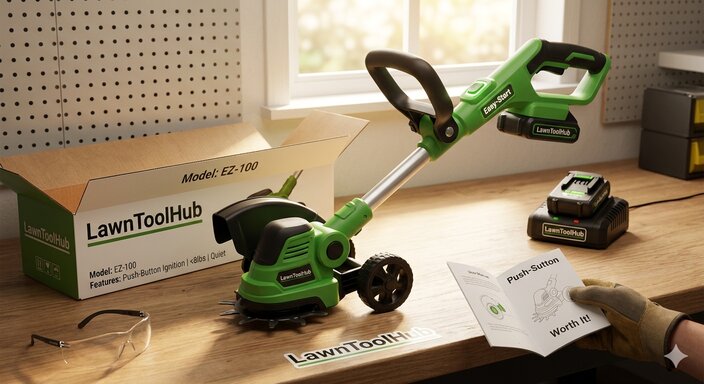
There is nothing quite like looking out at your property and seeing a crisp, razor-sharp boundary line separating your lush green turf from the concrete driveway. When I’m out in the yard on a crisp Saturday morning, that clean edge is what separates a truly manicured lawn from an average one. But let’s be honest: wrestling with a stubborn, heavy piece of machinery just to trim 40 feet of concrete walkway can turn a quick weekend chore into a frustrating workout. If you are managing a compact property, you have likely wondered: are easy-start lawn edgers worth it for small yards, or are they just an overpriced marketing gimmick?
In my experience, tool fatigue is the primary reason homeowners let their sidewalks become overgrown with creeping grass stolons. If you find yourself constantly struggling with massive, bulky commercial tools, looking into a lightweight lawn edger for women or anyone seeking a highly maneuverable, stress-free design can completely change your relationship with yard maintenance. A compact, effortless-starting tool removes the psychological barrier of firing up equipment for small tasks. Let’s break down exactly what “easy-start” means in the modern landscape, debunk the common myths around these tools, and answer the value question once and for all.
Myth vs. Fact: Debunking Easy-Start Edger Misconceptions
When people hear terms like “easy-start” or “effortless ignition,” a lot of old-school bias kicks in. Many homeowners assume that a tool designed to start effortlessly must be lacking in real-world cutting power or durability. Let’s look at what the engineering actually says.
Myth 1: Easy-start gas edgers are fragile and break down constantly.
- The Fact: Early mechanical spring-assisted pull cords did have durability issues a decade ago. However, modern gas-powered easy-start mechanisms use advanced compression-release valves or dual-spring pull systems that reduce pulling resistance by up to 40% without adding fragile plastic components. They last just as long as traditional recoil systems if you perform basic seasonal carburetor cleaning.
Read More: How to Choose an Ergonomic Lawn Edger That Won’t Hurt Your Back?
Myth 2: Electric and battery edgers don’t have enough torque to cut a clean edge in overgrown dirt.
- The Fact: This is a massive misconception left over from the days of weak, plug-in extension cord tools. Modern brushless electric motors paired with high-voltage lithium-ion batteries produce instant torque. Unlike gas engines that have to rev up to their power band, a battery-powered easy-start tool reaches full rotational speed the millisecond you pull the trigger, easily slicing through thick clay soil and dense warm-season grass roots.
Myth 3: If a yard is small, using a manual hand edger is always a better value.
- The Fact: While a manual rotary or half-moon step edger is cheap, it relies entirely on your body weight and back strength. If your small yard has tough, hard-packed clay soil, a manual tool will often deflect, leaving a jagged, uneven line. An easy-start power tool ensures a perfectly straight, vertical groove in a fraction of the time, regardless of your physical strength or soil density.
The Verdict: Are Easy-Start Lawn Edgers Worth It for Small Yards?
To determine if these specialized tools justify their price tag on a smaller property footprint, we need to analyze the direct relationship between tool weight, power source, and your physical setup.
Calculating the True Value of Effortless Ignition
For small yards, the value of an easy-start tool isn’t about running the machine for hours at a time; it’s about the ease of deployment. If you have to spend ten minutes priming a carburetor, adjusting a choke, and yanking a heavy cord until your shoulder aches just to edge a 20-foot driveway, you are going to skip doing it. When a tool features a simple push-button battery start or a smooth, low-resistance pull cord, you are far more likely to maintain your edges weekly. This prevents the turf from completely reclaiming the concrete, which saves you from major, exhausting overgrown lawn cleanups down the road.
Read More: Gas vs. Battery Edgers: Which is Easier to Maintain for Beginners?
Frequently Asked Questions
Which easy-start mechanism is best for a property under a quarter acre?
For small yards, a push-button battery-powered electric edger is almost always the superior choice over gas. There are no fuel mixtures to manage, no spark plugs to gap, and zero pull cords to tug. You simply slide the battery in, press the safety lock, and pull the trigger.
How do I maintain an easy-start gas edger so the mechanism doesn’t fail?
If you choose a gas model with a spring-assisted starter, the number one rule is to never “snap” the cord back into the housing. Pull smoothly until you feel the spring engage, let the engine fire, and guide the rope gently back into the recoil assembly. Additionally, always use fuel stabilizer or ethanol-free gas to prevent old varnish from clogging the internal valves, which forces you to pull harder on the cord.
Can an easy-start electric edger handle thick grass overgrowing onto a sidewalk?
Yes, but you need to use the correct technique. For the first initialization cut of the season, lift the edger slightly so the blade isn’t buried deeply into the hard dirt immediately. Make a slow, shallow pass to clear the bulk of the overgrown grass blades. Once the initial channel is open, drop the wheel depth adjustment down to its full depth (typically 1 to 1.5 inches) and make a final pass to lock in that perfect, professional groove.
How often will I need to replace the blade on a small-yard edger?
On a small residential property, a standard steel edging blade will typically last one full mowing season. If you frequently strike the side of concrete curbs or pavers, the blade will wear down or dull faster. Check the blade length every month; if it has worn down more than an inch from its original factory size, replace it to avoid putting unnecessary structural strain on the tool’s motor.
