
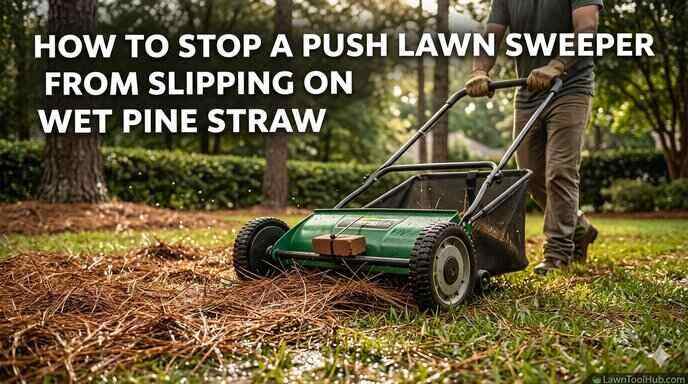
There is nothing quite like looking out over your yard and seeing a clean, immaculate carpet of green turf. It makes all the sweat equity worth it. But if your property is surrounded by majestic, towering pines, you know that managing the debris drop is a constant, year-round battle. When I’m out in the yard trying to clean up after a heavy storm, few things are more frustrating than a tool that refuses to cooperate. If you’ve ever tried to clear your grass after a steady downpour, you’ve likely faced a frustrating mechanical headache and want to know exactly how to stop a push lawn sweeper from slipping on wet pine straw.
The problem is rooted in basic physics. Most homeowners purchase a lightweight push sweeper for picking up pine needles assuming it will glide effortlessly across any surface. But wet pine straw creates a slick, interlocking mat over your turf while simultaneously lubricating the sweeper’s plastic tires. Because these machines rely entirely on wheel traction to spin the internal collection brushes, slipping wheels mean dead brushes. Let’s look at a real-world backyard scenario, analyze what goes wrong mechanically, and map out the exact adjustments needed to restore absolute traction.
A Common Backyard Mistake: The Slick Surface Meltdown
To understand the solution, let’s look at what typically happens during a messy weekend cleanup. Last spring, after a brutal three-day rainstorm, my yard was completely buried under a heavy, orange blanket of soggy pine needles. Eager to get the yard looking sharp before the weekend, I grabbed my standard push sweeper and headed out.
Within five feet, the project stalled. Every time I pushed the handle forward, the wheels simply locked up and skidded smoothly across the wet grass like plastic sleds on snow. The brushes didn’t spin a single time, and the heavy mat of pine straw remained completely untouched.
What went wrong? This common failure happens due to a combination of three distinct factors:
- The Lubrication Layer: Wet pine needles release natural oils and sap when compressed. This creates a highly lubricated, low-friction barrier between the rubber or plastic wheel tread and the grass blades underneath.
- Excessive Downward Resistance: Wet pine straw loses its fluffiness and packs tightly together, weighing up to three times more than dry needles. When the collection brushes hit this heavy, waterlogged mass, they require massive torque to lift it.
- Zero Tire Penetration: Because push sweepers are intentionally engineered out of lightweight plastics and thin aluminum tubes to make them easy to push, the tires lack the downward gravitational force required to bite through the slippery needle mat and grab the soil.
Instead of forcing the tool and stripping the internal plastic gears, you have to systematically alter the traction dynamics of the machine.
Step-by-Step Fix: How to Stop a Push Lawn Sweeper from Slipping on Wet Pine Straw
If your machine is skidding and refusing to sweep up soggy debris, do not panic. You can easily modify your technique and your tool using common household items. Follow these sequential steps to get your brushes spinning at full speed again.
Step 1: Add Localized Ballast Over the Drive Axle
The fastest way to combat tire slippage is to physically force the wheels into the ground. Since the machine itself lacks weight, you need to provide some mechanical down-force directly over the tires.
- Locate the front horizontal support bar running between the two main wheels.
- Grab a 5-pound or 10-pound vinyl barbell plate, a heavy brick, or an old sandbag.
- Secure the weight firmly to the front crossbar using heavy-duty zip ties, a ratcheting tie-down strap, or a strong bungee cord.
- Safety Warning: Do not place the weight inside the fabric hopper basket, as this pulls the rear of the machine down and actually lifts the front drive wheels off the grass. Keep the weight strictly over the front axle line.
Step 2: Elevate the Brush Height to the “First-Pass” Position
When dealing with heavy, wet debris, trying to scoop everything up in a single pass will instantly stall your tires. You need to reduce the mechanical resistance against the brush drum.
- Locate your sweeper’s height-adjustment knob or lever.
- Raise the brushes completely until they are barely skimming the top third of the pine straw mat.
- Walk the yard at a steady pace to skim off the loose, floating top layer of needles.
- Once the bulk weight is removed, lower the deck by one notch and make a second pass to sweep up the deeply embedded material.
Step 3: Enhance Tire Grip with DIY Tire Chains
If your sweeper utilizes smooth plastic wheels rather than rubber treads, it will naturally struggle on wet turf. You can easily increase surface aggressively without buying specialized parts.
- Wrap thick, heavy-duty 11-inch nylon zip ties completely around the tire tread, spacing them roughly two inches apart around the entire circumference of the wheel.
- Pull the zip ties tightly using a pair of pliers so the thick locking heads sit squarely on the center of the outer tread.
- Snip off the excess plastic tails cleanly with wire cutters.
- The protruding plastic locking heads act exactly like miniature tire cleats, biting deeply into the slick pine straw mat and forcing the wheels to turn instead of slide.
Step 4: Maximize Forward Momentum and Pathing
Because your walking speed directly controls the rotational velocity of the brushes, a slow stall-and-start pace will guarantee wheel slippage.
- Start pushing the sweeper on a clear, dry patch of grass or a nearby sidewalk to get the brushes spinning safely before you hit the heavy debris zones.
- Maintain a fast, athletic walking pace. High forward momentum creates intense centrifugal force at the brush tips, allowing them to slice through wet clumps rather than getting trapped by them.
- Work in straight, continuous lines. Avoid making sharp turns while buried inside a thick pile of straw, as the inside wheel will immediately lose traction and slide.
Essential Post-Cleanup Tool Maintenance
Wet pine straw is highly acidic and coated in sticky resin. If you store your sweeper away immediately after working in wet conditions, you will rapidly degrade the internal mechanical components.
- Purge the Gear Assemblies: Flip the sweeper upside down and remove the main drive wheels. Wet needles have a tendency to wrap around the central spindle, dragging grit and wet sap straight into the plastic pinion gears. Clean these out with an old toothbrush and apply a liberal coat of water-resistant marine grease.
- Dry the Hopper Canopy: Never leave wet, heavy pine straw sitting inside the fabric collection bag for more than a few hours. The trapped moisture will cause mold and mildew to rot the stitching, causing the hopper floor to sag and drag on the grass during your next backyard session. Empty the basket completely and leave the unit propped up in a sunny, well-ventilated garage to dry out completely.