
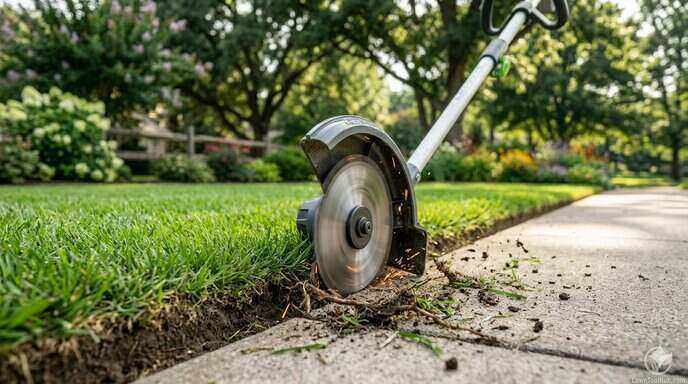
That clean, razor-sharp line between your lush green grass and a concrete walkway is the ultimate yard status symbol. It completely transforms your property’s curb appeal from standard to spectacular. When I’m out in the yard on a clear morning, my edger is the exact tool I rely on to lock in that professional, crisp look. But let’s be honest: migrating away from loud, heavy gas equipment over to modern cordless tools introduces a brand-new mechanical learning curve. If you don’t adjust your technique, you are bound to fall into a few 5 common mistakes when using a metal blade battery edger.
Electric motors run on completely different power principles than internal combustion engines. While a high-torque battery edger with a cutting blade gives you incredible convenience and clean slicing action, it can easily suffer from hidden mechanical strain if you misuse it. Treating a battery tool like a gas-guzzling brute will rapidly kill your battery runtime, shred your landscaping, and potentially fry your equipment. Let’s look at a few major yard blunders I see neighbors make all the time, and look exactly at how you can prevent them to protect your spine, your lawn, and your investment.
The Anatomy of an Edge Gone Wrong: What Happens Under the Hood
When you drop a spinning steel disc into a mix of dirt, rocks, and thick grass roots, physics takes over. Mismanaging the tool’s settings or angle creates distinct, invisible problems for your cordless gear.
| The Operator Mistake | Immediate Turf Damage | Hidden Mechanical Impact |
| Slamming the Blade into Soil | Ragged, brown torn grass roots and ugly trenches. | Severe amp draw spikes that overheat the brushless motor. |
| Riding Too Deep | Displaced subsoil, buried rocks kicked up onto the lawn. | Drastic loss of battery capacity; high wear on the spindle. |
| Pushing the Wrong Direction | Jagged lines, zero control over straight tracking. | High kickback force traveling up the shaft to your wrists. |
| Scraping Hard Concrete | Flying steel sparks and chipped, ugly sidewalk borders. | Rapidly rounds out the steel blade corners and warps the arbor. |
5 Common Mistakes When Using a Metal Blade Battery Edger (And How to Fix Them)
Let’s break down the exact operational errors that kill your hardscaping efficiency and walk through how to bypass them like a seasoned pro.
1. Digging Deep Enough to Excavate Subsoil
One of the most widespread 5 common mistakes when using a metal blade battery edger is dropping the wheel adjustment depth as low as it can physically go. I get the temptation—you want a deep, dramatic canyon separating your grass from your walkway. But plunging a steel blade two or three inches straight into thick clay or packed sand creates immense physical friction.
- The Fix: Your edger is a groomer, not a trench-digger. Adjust your tool’s depth gauge so the steel blade drops only a modest half-inch to three-quarters of an inch below the concrete surface. This is more than enough depth to cleanly slice through the stolons of aggressive, creeping warm-season grasses like Bermuda or St. Augustine while allowing the motor to spin freely at maximum RPM.
2. The Dreaded “Ground Start” Pull
Never, under any circumstances, place your edger blade directly down inside a dirt trench before you squeeze the power throttle. Electric motors demand a massive surge of current (amperage) to transition from a dead stop to full operating velocity. If the steel face is already wedged tight against packed soil and root systems, it creates immediate electrical resistance.
- The Fix: Always practice the “air-start” rule. Hold the edger completely steady with the blade suspended roughly two inches clear of the ground. Pull the trigger all the way down, let the brushless motor whine up to full, unrestricted spinning speed, and then smoothly lower the rotating blade into your guiding path. This protects your lithium-ion cells from sudden voltage drops and prolongs battery life.
3. Pushing Forward Instead of Back-Scraping
Most traditional instructions show operators strolling forward casually down their sidewalks. While this works beautifully once a deep dirt track is already well-established, pushing a metal blade forward into heavily overgrown early-season turf often causes the blade to catch on high earth contours. The tool will repeatedly jump out of the track, skittering wildly across your nice concrete.
- The Fix: For your first major cleanup pass of the season, try standard back-scraping. Position yourself securely, bring the machine up to full speed, and slowly pull the edger backward toward you along the sidewalk edge. This pulling motion allows the natural rotation of the blade to cleanly lift dirt out of the trench rather than forcing the tool’s housing down into it, giving you total control over the tracking line.
4. Continuous, Brutal Curb Scraping
Steel blades are highly durable, but concrete is harder. Intentionally jamming the side of your spinning steel disc flat against your concrete curbs creates a horrible shrieking noise, massive heat buildup, and a shower of bright orange sparks. This friction rapidly dulls the cutting edge, turning your crisp slicer into a blunt hammer that tears at your turf.
- The Fix: Leave a tiny, fraction-of-an-inch spacer gap between the blade and the stone. Use your guide wheel to track straight, but lean the tool’s shaft a hair away from the hardscaping. If you hear continuous grinding, your angle is too tight. The blade should only make occasional, light contact with the sidewalk face as it tracks.
5. Neglecting the Underside Debris Guard
Because cordless lawn edgers run incredibly quiet compared to old-school gas models, it is very easy to miss the early warning signs of mechanical drag. As you cut through damp soil and morning dew, a thick paste of wet mulch, grass clipping pulp, and small pebbles packs tightly inside the protective plastic blade guard.
- The Fix: Make it a strict habit to pull your battery pack completely out after every single yard session. Flip the tool over on your workbench and use a stiff putty knife to scrape out all compacted mud layers from inside the guard shell. Clearing this hidden debris eliminates parasitic drag, instantly giving you back 15% to 20% of your total battery runtime per charge.
Pro-Tip: The String Trimmer Check
If a section of your lawn has overgrown the concrete by several inches, do not try to plow through it all with your edger blade on the first pass. Take your standard string trimmer out first, scalp down the overhanging green canopy vertically so you can see exactly where the stone edge meets the earth, and then drop in your metal blade edger to carve out the clean dirt groove.